“We’ve done this before. Where is it?”
Past work sits across folders, versions and inboxes.
Start from relevant past work
Describe the client need and surface useful previous material, with sources visible.
Beyond the Silo helps knowledge-intensive consultancies find, adapt and build from past work, so teams deliver faster while bringing fresh insight to every project.
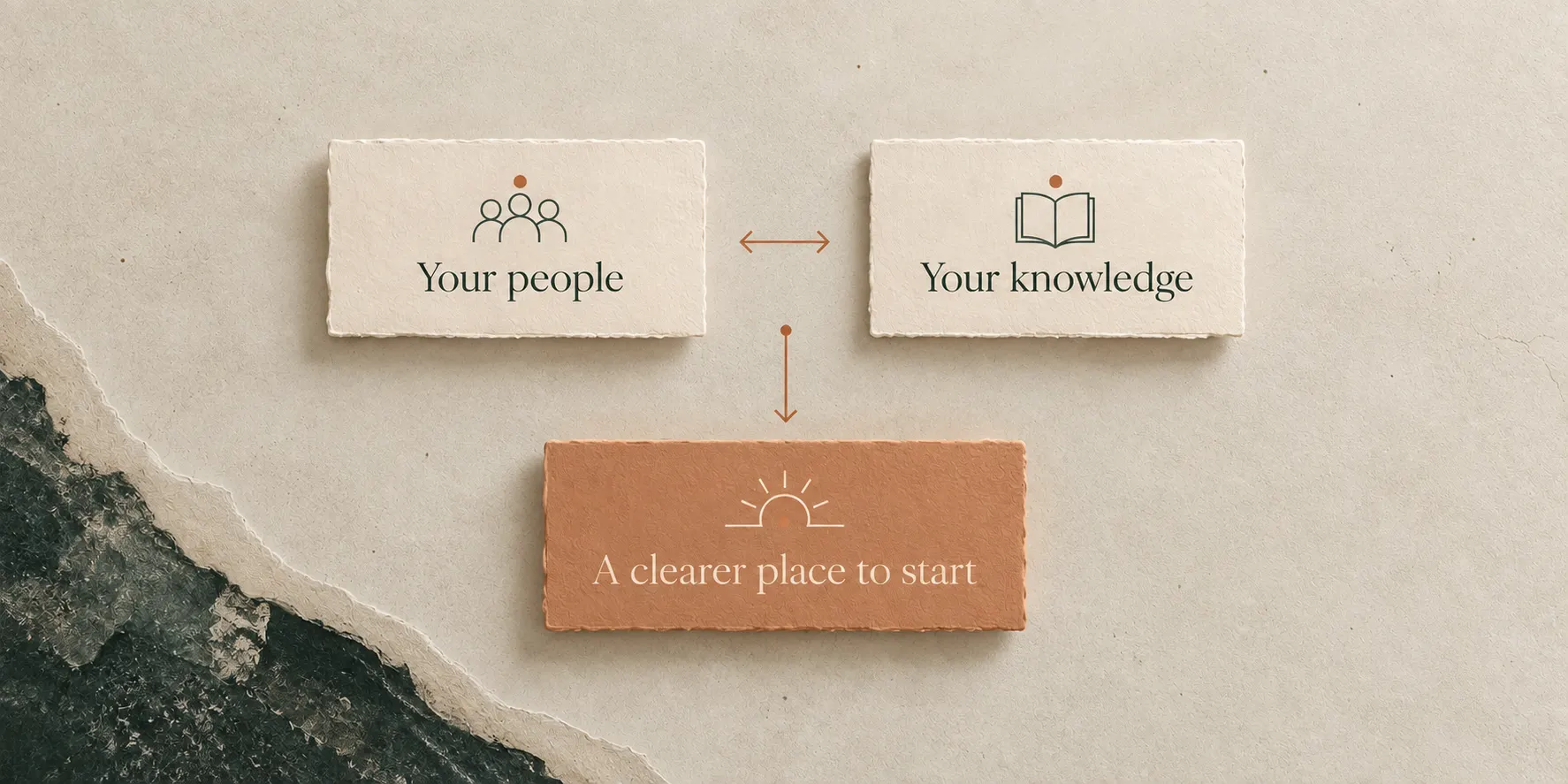
Map. Choose. Prove. Build. Refine.
 01
Map the work
01
Map the work
We begin by understanding how client work is currently created, where useful knowledge already lives and what what can be built on without compromising confidentiality.
This includes your current tools, templates, methodologies, repeated work, confidentiality boundaries, permissions, current AI usage and the knowledge that still sits in people’s heads.
 02
Choose the workflow
02
Choose the workflow
From the map, we identify the client-delivery workflow with the greatest potential to save time, reduce costs or increase capacity for more client work.
This might be proposals, reports, workshop design, research synthesis,recurring deliverables, or another repeated piece of work. We then define what success needs to look like before anything is built.
 03
Prove the value
03
Prove the value
Before moving into full implementation, we test the chosen workflow on a bounded set of real material.
This gives you a clear picture of how the solution would work with your existing knowledge team, what it can deliver and how much time it can save you. commitment.
 04
Connect the right sources
04
Connect the right sources
Depending on what is right for your team, this may mean configuring your existing Microsoft or Google environment, adding a third-party layer, or building something more bespoke.
The aim is not to create another place to manage knowledge. It is to connect the approved sources your team already uses and make them easier to work from.
 05
Build and refine the workflow
05
Build and refine the workflow
The consultant explains what they are trying to create, adds useful context, and the system retrieves relevant previous material.
That material is combined with your templates, methodologies, instructions and consultant input to create a working starting point. Your team then edits, challenges, adds judgement, and refines the output.
We test real scenarios, tune the workflow, train users, document appropriate use, and confirm the agreed criteria have been met.
Start with the workflow that would make the biggest difference.
The shift
Past work sits across folders, versions and inboxes.
Describe the client need and surface useful previous material, with sources visible.
Models, articles and notes gathered over years are easy to miss when new work begins.
Surface relevant references alongside previous client work, giving your team a richer base to build from.
Valuable client work cannot simply be copied, shared or reused without care.
Keep sources, permissions and review steps visible, so knowledge can be reused without losing control.
Your team pieces together old files before they can add fresh thinking.
Bring relevant material into a source-informed draft shaped around your approach, ready for your team to refine.
Useful expertise is hard to access when only one person knows where to look.
Give your team a shared route into reusable knowledge, without relying on individual memory.
The outcome
Find past work that matches the client need, instead of relying on memory or folder searches.
Bring relevant previous work, useful references and the right template together before shaping the next deliverable.
Carry your language, frameworks and ways of thinking through new work more reliably.
Make expertise easier to access across the firm, not just by the people who remember where it lives.
Success is defined with you and tested against your own work.
The founder
I grew up around the language of leadership, culture, organisational psychology and facilitation. I know how much care sits behind a strong piece of client work: the framing, research, workshop design, careful wording and judgement that makes it fit the room.
I now work as a software developer with a focus on AI, retrieval and practical workflow design. Beyond the Silo brings those worlds together: the human craft of consultancy delivery and the technical systems that can help good work travel further.
The aim is not to make your work generic. It is to help your team reuse its own thinking with more confidence, more consistency and less wasted effort.
Evidence first. Build second.
Before any full implementation, we test whether the opportunity is real using your material and agreed criteria. If the value is not clear, you stop there. If the build goes ahead, we refine it until those criteria are met.
Questions
That is the starting point. We look at how your team uses Microsoft 365, Google Workspace, shared drives or other repositories before recommending an approach.
We agree what can be used, who can access it and what needs to be removed, restricted or de-identified. Hosting, permissions, providers and retention are reviewed before implementation.
No. The workflow helps find relevant material and prepare a stronger starting point. Your consultants review the sources, adapt the thinking and remain responsible for the final work.
No. We lead the technical work. Your team brings the knowledge of your methods, clients and what a useful result looks like.
A typical engagement depends on the number of sources, access requirements and the workflow being built. The work is staged, with a clear decision point after the proof-of-value test.
It is designed for boutique firms with a body of previous work and recurring delivery needs. Fit depends less on exact headcount and more on whether your past work can support future delivery.
Pricing is scoped by stage. You receive a clear scope and price before each step, starting with the knowledge map and proof-of-value test.
Let’s look at where your team spends time recreating, searching and assembling client materials—and whether a secure reuse workflow could give you a better starting point.
For boutique leadership, culture and people consultancies. No obligation.